

 DE
 EN






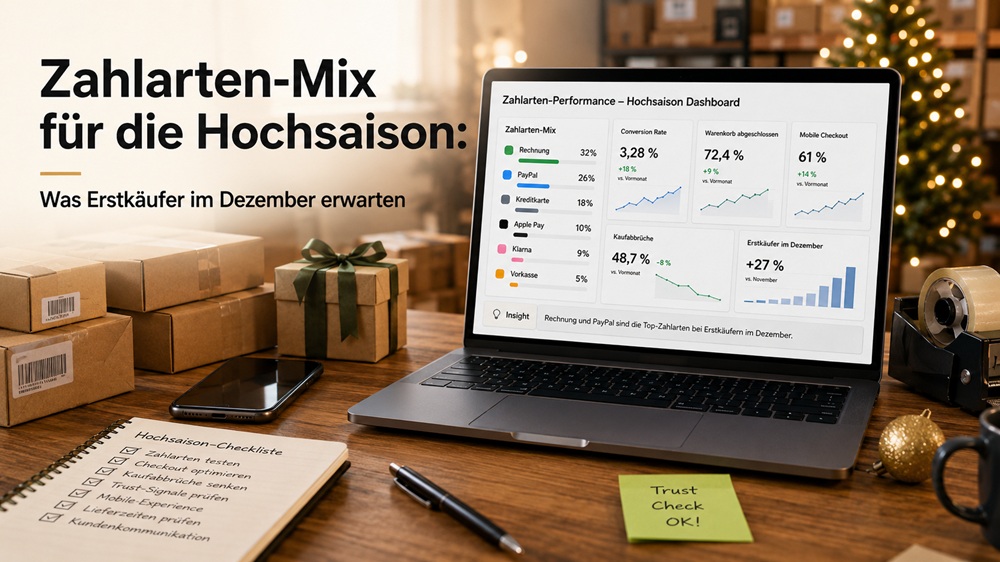

In December, someone who doesn't know you buys from you. They're looking for a gift, are in a hurry, found you through an ad or a search query—and at checkout, they make a decision that your regular customer wouldn't make back in June: Do I trust this shop enough to give them money before I've received anything in return?
The previous article on load testing focused on whether your shop can technically handle the number of visitors. Today, we'll discuss the last three clicks : Which payment methods should be displayed, how many are too many, and what happens if the one method a visitor expected is missing.
First, to be clear about what this is n't about: This isn't a provider comparison. We've already analyzed which payment service provider is best suited to your shop in our Payment Provider Comparison . This is about the combination – the mix that's visible at checkout.
The number that most shops misread
Almost every shop knows its payment method distribution. Almost everyone misinterprets it because they only look at one of two rankings.
The German Federal Bank (Bundesbank) regularly surveys payment behavior across Germany, most recently with around 6.000 respondents and a three-day payment diary. For online shopping, two rankings appear side-by-side, and they contradict each other. Based on the number of transactions , internet payment methods like PayPal clearly lead with 50 percent, followed by direct debit and bank transfer with 30 percent, and credit cards with 15 percent. However, when considering revenue , the picture reverses: direct debit and bank transfer account for the largest share at 45 percent, while internet payment methods reach 32 percent—seven percentage points lower than in the previous survey. This information can be found in the German Federal Bank's Payment Behavior Study.
Translated: The payment method used for the most orders is not necessarily the one that generates the most revenue. Those who evaluate their payment mix based solely on order volume optimize for small orders and overlook what drives larger transactions. Those who focus only on revenue might eliminate the payment method that accounts for the majority of purchases.
Both lists are also available for your own online store, without any additional tools: Every shop system provides the order-based analysis , as does the revenue-based one. Comparing the two takes ten minutes and is the only preparation this article truly requires. Experience shows that in shops with a mixed product range, the two rankings differ significantly more than the owners expect—especially where an expensive segment is located alongside many lower-priced items.
Among online payment methods, PayPal is by far the most widely used single method, accounting for around 86 percent of transactions—which in practice means it's not just one payment option among many, but rather the standard expectation for a large portion of your visitors. And for 18- to 25-year-olds, nearly 70 percent of online payments are processed using such methods. If your target audience is young, the discussion about alternatives is shorter than you might think.
Why the December buyer is a stranger
Now for the hypothesis, for which there are no statistics, only project experience—let's be frank about it: In the fourth quarter, the mix of your visitors shifts. The proportion of first-time buyers increases because people are looking for gifts outside their usual shops. And a first-time buyer brings a shopping guide to checkout that your regular customer has long since discarded.
You can read what this guide sounds like. The Hamburg Consumer Center evaluates payment methods for online shopping based on security and classifies purchasing on account as the safest method: payment is only made once the goods have arrived. The reasoning is precisely the mistrust that first-time buyers bring with them—in essence: even a professional-looking shop doesn't reveal who is behind it. The same website also notes that retailers are free to decide which payment methods they offer, but must provide transparent information about them.
This doesn't create an obligation to pay by invoice. It creates an expectation that your checkout process either addresses or fulfills. In our projects, we regularly observe that shops with high-priced shopping carts and no invoice option lose visitors in December precisely where nothing else is amiss. This correlation isn't supported by any study we've found—therefore, it's presented here as an observation, not a numerical figure.
One detail that's often overlooked: "Buy now, pay later" offered by some payment services is different from buying on account directly from a retailer. Consumer protection agencies explicitly warn against equating the two – with the service provider model, the money is transferred earlier and is more similar to prepayment. For your marketing, this means: Clearly state what the customer receives, not just the label.
The four roles in the mix
More helpful than a list of providers is the question of what role each payment method plays in your checkout process. Four roles should be filled—by whom is secondary.
Trust: buying on account
It takes the risk away from the first-time buyer and shifts it to you. That's the whole point—and the reason why it works. Those who offer it need a risk assessment; those who don't need a strong argument at this point in the checkout process, such as visible buyer protection information or a clear return policy.
Convenience: the wallet
One click, no form, no typing in a card number—on a mobile phone, that's the difference between a purchase and a cancellation. The price for this is fees and a piece of the customer relationship that remains with the provider. According to figures from the Bundesbank, this role is the most frequently used of all.
Range: the map
It's the payment method for everything that happens outside your core market and for customers who don't want a digital wallet or an invoice. However, it does involve an additional step: confirmation by the bank via app or TAN. For someone who quickly orders a gift in the evening and doesn't have their bank-issued mobile phone handy, this is a real hurdle. Expect it, rather than being surprised.
Costs: the direct debit
Low fees, popular with regular customers, risky with strangers — the merchant bears the cost of returned direct debits. In the Bundesbank's sales ranking, it's right at the top, alongside bank transfers, demonstrating that where trust already exists, large sums of money flow.
If one of these four roles is vacant, you are not missing “a payment method”, but a customer type.
How many payment methods are too many?
The obvious answer—the more, the better—is wrong, and this isn't just based on personal experience. The Cologne-based retail research institute IFH warned as early as 2022 against expanding payment options based on quantity over quality: an overloaded checkout quickly becomes confusing and overwhelms customers. The corresponding analysis, in which the IFH warns against an overloaded checkout , cites a remarkable average for context: as early as the beginning of 2022, retailers offered an average of 8,3 payment methods.
There's no reliable target number, and anyone who gives you one has simply made it up. A rule of thumb we've learned from our projects is: Fill the four roles effectively before adding the fifth, sixth, and seventh options. Every additional tile takes away attention at the point where the customer has already decided to buy—and every second spent thinking about it works against you.
The more honest test is not the number, but the usage: If a payment method remains in the low single digits for months and has no strategic reason, it causes maintenance effort, contract costs and selection stress without contributing anything.
Order and presentation — more is decided here than you might think.
There is no German institute study we could cite for this section. What follows is explicitly based on experience from shop projects, not statistics.
Sort by actual usage, not by contract age. The most frequently used payment method should be at the top. In almost every shop we acquire, the order is still the same as it was when we set it up.
Use logos that the customer recognizes. Brand recognition is precisely the initial trust that first-time buyers crave. A simple text link like "Payment via provider X" doesn't achieve that.

Display the payment methods before checkout. On the product page, in the shopping cart, in the footer. Customers who only find out in the last step that their payment method is missing will have already entered their address details by then — and will leave with significantly more frustration.
Beware of surcharges. Additional charges for certain payment methods are subject to strict legal limitations and affect the most sensitive point in the purchase process. If you need them, they should be communicated transparently and early on, not as a surprise at the last step.
And guest checkout is part of it. A first-time customer ordering a gift doesn't want to create an account. The combination of mandatory account creation and an unfamiliar shop is the most costly mistake in this list. We've compiled other typical checkout friction points in our article on abandoned checkouts.
The part that only December presents: gift, deadline, return
An order placed in December has two characteristics that an order placed in June lacks: it has a deadline, and it's usually not for the person placing the order themselves. Both of these factors affect even the payment method—this is an observation from projects, not a study.
The deadline. Anyone ordering on December 19th isn't just buying a product, but a delivery promise. Payment methods that involve prepayment lengthen the process: the goods aren't shipped until the money has been received. If you offer prepayment, this tile should clearly state what this means for the delivery date—not in the shipping terms, but where the decision is made. Conversely, payment by invoice and digital wallet are your fastest delivery options at this stage.
Returns. Gifts are returned more often than self-purchased items, and the recipient didn't make the purchase. How quickly and by what means the buyer gets their money back depends on the payment method: With a digital wallet, the refund is usually a matter of days; with a card, it can take longer; and with advance payment by bank transfer, bank details are required—meaning an additional contact that nobody wants in January.
If you advertise an extended return policy in December, as many shops do, check beforehand whether your refund process can handle it. A generous promise with a slow refund process creates more problems than no promise at all.
The risk side: Those who don't check pay the price.
Offering payment by invoice means making an advance payment. This is not a service decision, but a risk decision – and it involves significant costs.
Merchandise and merchandise credit fraud, which includes ordered but never paid-for goods, remains a widespread crime. The Federal Criminal Police Office's (BKA) crime statistics show approximately 194.500 recorded cases for 2025—16,9 percent fewer than the previous year. The BKA considers it possible that this decline is related to stricter security measures in online retail and the increasing use of two-factor authentication for payment processing; however, the statistics do not explicitly state this as evidence. Bucking the trend, fraud involving illegally obtained non-cash payment methods rose to just over 96.000 cases, an increase of 4,8 percent, with a clearance rate of only 21,1 percent.
Two things should n't be inferred from this: The statistics don't include monthly figures, so they say nothing about December. And they don't show a shift from one payment method to another. However, what they do show is sufficient for a practical conclusion: An open invoice process without verification is not a minor detail.
In practical terms, this means: offer payment by invoice with credit and plausibility checks, set spending limits for new customers, and handle discrepancies between the delivery and billing addresses separately. Those who don't want to bear the risk of default themselves can outsource it to a service provider—in which case the cost of this protection must be included in the calculation, and the checkout process should contain text describing what actually happens.
What you should do now — and what you shouldn't touch in November
September is the right month for payment methods. Not because the date is magical, but because of the lead times: a new contract, activation, testing, adjustments in the shop and accounting system—these take weeks, not days. This assessment comes from our projects; there is no official source specifying deadlines.
This week: Analyze the distribution of payment methods over the last twelve months—once by orders, once by revenue. These are precisely the two rankings that the German Federal Bank also publishes separately. If a payment method is at the bottom of both lists, you have a candidate to discontinue.
In September: Fill in the gaps in the four roles. Place a complete order in your own shop using each payment method, on your mobile phone, with a fresh browser profile – in other words, as the stranger you will be in December.
In October: Clean up the order, logos, and text. Check what legally required elements the checkout must display; the obligation to include a cancellation button , for example, is newer than many realize.
From November onwards: no more changes. No new payment methods, no switching providers, no changing the checkout order. The only sensible intervention during this time is to shut down anything that's broken.
And test the payment methods under load, not just in an empty shop. The payment process is the most expensive part of your system and the point where queues first form when there's a surge in demand. If your checkout is technically at its limit, even the best mix of payment methods won't help—what you need first and foremost is a streamlined, fast checkout process.
Frequently asked questions about payment methods in the online shop
What payment methods should a German online shop offer at a minimum?
Think in terms of roles, not names: one method for trust (purchase on account), one for convenience (wallet or online payment method), one for reach (card), and one for cost-effective processing for regular customers (direct debit). Which providers fill these roles depends on their product range, average order value, and target market. According to figures from the German Federal Bank, online payment methods are by far the most frequently used method in online shopping in terms of the number of transactions, while direct debit and bank transfer account for the largest share of sales.
Why is buying on account so important in Germany?
Because the customer only pays once the goods arrive—and therefore bears no risk. The Hamburg Consumer Center thus classifies payment by invoice as the safest payment method for online shopping, citing the fundamental problem that you can't tell who is behind an unknown shop. Conversely, for retailers, this means the risk lies with them, which is why payment by invoice without a credit check and without a minimum purchase amount is not a good idea for new customers.
How many payment methods are too many?
There are no reliable figures for this. The IFH Cologne already warned in 2022 against expanding the range of payment options based on the principle of quantity over quality, because an overloaded checkout process becomes confusing and overwhelms customers; on average, retailers offered 8,3 payment methods at that time. Our recommendation from project experience: first, ensure that the four roles are properly filled, then check whether a fifth option truly appeals to a specific customer type—and deactivate payment methods that are hardly used for months.
Do I have to offer payment methods that I don't want to offer?
No. Merchants are free to decide which payment options they offer; consumer protection agencies also point this out. Transparency is mandatory : Customers must be able to see how they can pay and what that means for them before making a purchase. Additional charges for individual payment methods are also legally restricted and, if they exist at all, must be communicated clearly and early on.
What is the risk of fraud when buying on account?
It's a real problem, not a fringe phenomenon. Police crime statistics show approximately 194.500 cases of merchandise and merchandise credit fraud for 2025, 16,9 percent fewer than the previous year; at the same time, fraud involving illegally obtained non-cash payment methods rose to just over 96.000 cases, with a clearance rate of only 21,1 percent. The statistics do not include monthly figures, so they don't reveal any particular situation in December. The bottom line for the shop remains: Purchases on account require verification.
When should I change payment methods before the peak season?
As early as possible, but no later than September and October. Contract signing, activation, technical integration, and testing take weeks in practice, in addition to adjustments in accounting and inventory management . From November onward, you shouldn't change anything in the checkout process—the only sensible intervention during this time is to deactivate something that demonstrably isn't working.
Conclusion: Four rolls, not twelve tiles
The mix of payment methods isn't a collection one wants to have completely, but rather a selection that must fulfill four tasks: trust, convenience, reach, and cost. Anyone who thinks this way will have a short discussion this fall instead of a long one.
And the one figure worth taking from this report is the Bundesbank's dual ranking: orders and sales are distributed differently across the payment methods. Anyone who only knows one of the two lists will be making a decision in December based on incomplete information.
What does your mix look like?
Which payment method is listed first in your checkout — and when did you last change this order? My guess is that it's still the same as when you set up the shop.
And the question where I expect the more interesting answers: Which payment method did you deactivate—and what happened afterward? This is the experience that hardly anyone writes about because it's difficult to tell as a success story. If you've gone through this, please feel free to write to me.
If you would like to have your checkout process reviewed by someone else, you can contact us via the contact page.
This post is part of our Q4 series. Every Tuesday, a new post will be published here to help you prepare for the peak season. Next week: Communicate shipping costs and delivery times before the customer asks.




 {% endif %} {% if title and title != "" %}
{{ title }}
{% endif %} {% if excerpt and excerpt != "" %}