

 DE
 EN























Customers don't ask about shipping costs. They leave. That's the inconvenient part: there's no email, no chat, no phone call to let you see how often a missing or delayed figure has cost you an order. The customer silently asks their question—and answers it by closing the tab.
The previous article on payment methods focused on the payment options themselves, i.e., how someone pays. Today, we'll discuss the two figures that appear right next to them and are the subject of far more frequent arguments: What does shipping cost, and when will the package arrive? Neither of these is a marketing decision. Both are first and foremost a necessity, then a data issue—and only as a last resort is it a matter of wording.
First, a distinction: The psychological aspects—thresholds, free shipping, perception—are covered in " What Online Shoppers Really Think About Your Shipping Costs ," and why the large banner at the top often remains ineffective is explained in " Why Your 'Free Shipping' Banner Ignored ." This article focuses on the less spectacular aspects: mandatory information, the question of where the delivery time in your shop actually comes from, and why the product page, shopping cart, and checkout process in a surprisingly large number of shops display three different answers.
The two numbers nobody asks about
Let's start with what is non-negotiable. The Price Indication Ordinance, as amended in 2022, requires two things in Section 6 : You must state whether freight, delivery, or shipping costs, or other charges , are added to the price. And if they are, their amount must be stated—in the words of the ordinance: "insofar as these costs can reasonably be calculated in advance."
This clause is the interesting one. "Reasonably calculated in advance" doesn't mean "whenever it suits you," but rather it establishes a limit of what's reasonable. Anyone offering a flat shipping rate for Germany can calculate it—so they have to state it. Someone needing a freight forwarder for bulky goods and only knowing the price after measurements are in a different situation. The practical consequence for the vast majority of shops with a standard product range: the figure is calculable, so it must be displayed, and before the customer even begins the ordering process.
The delivery time is listed next to it in the same category. The pre-contractual information requirements for distance selling explicitly state "the terms of payment, delivery, and performance, the date by which the seller must deliver the goods [...]". This information is due before a decision is made, not just in the order confirmation . Anyone using phrases like "shortly" or "as soon as possible" here hasn't provided any specific information, but rather expressed a general sentiment.
A disclaimer that belongs in a text like this: We are a shop agency, not a law firm. What's written here is an assessment based on our project experience, including references to the relevant standards—for a legally binding evaluation of your shop, please consult a licensed attorney. What we can handle for you is the technical aspect: ensuring that the number actually appears in the correct place.
One price, two truths
How quickly a minor oversight can escalate into a legal issue is illustrated by a complaint filed by the German Competition Authority in November 2022. A sports aid was advertised on Google Shopping for €12,29 with free shipping . However, the online shop itself charged €6,00 for shipping; free shipping was only offered for orders over €110,00. Furthermore, there was a minimum order value of €50,00, which was not mentioned in the portal overview. The Competition Authority considered this misleading advertising under the Act Against Unfair Competition and a violation of the Price Indication Ordinance; the company submitted a legally binding declaration to cease and desist. This can be read in the article " Maintaining Price and Order Transparency ."
What's remarkable about this case isn't the audacity—but rather that it probably wasn't audacious at all. Such a discrepancy rarely arises intentionally. It occurs because the shipping cost field in the product data feed was once set to zero when there was actually a free promotion, and then never touched again. The shop configuration remains active, the feed remains active, and neither is aware of the other.
Therefore, specifying shipping costs is not just a legal issue, but a data issue. Your shop isn't the only place where this figure appears: it's in the Google Shopping feed, in marketplace integrations, on price comparison portals, on the shipping cost page, in automated emails, and possibly even in an invoice template. We explained how to set up this feed correctly in our pre-season article on product data feeds —shipping costs are one of the fields that most frequently become outdated because they don't belong to anyone.
The question is therefore not "is my shipping cost information correct," but rather: In how many places is it displayed, and who notices when it changes in one of them? In the shops we acquire, this answer is rarely known completely—not due to sloppiness, but because the figure has been duplicated in new places over the years.
This is how shipping costs and delivery times can be structured in your online shop :
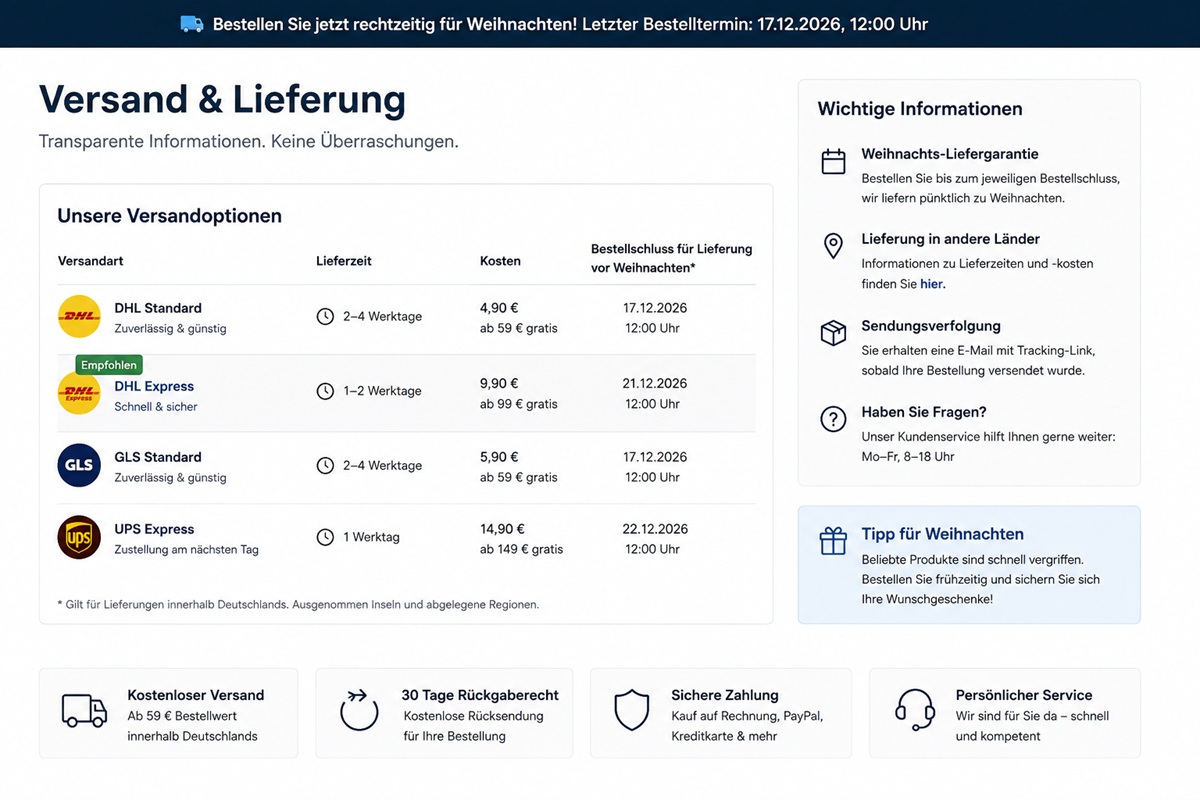
Example shipping display in an online shop – E-commerce news – Tips & tricks – Communicate shipping costs and delivery time before the customer asks
Where your delivery time really comes from
Shipping costs are about maintenance. Delivery time is about something more fundamental: whether your shop even knows what it's claiming. Broadly speaking, there are three types, and most shops operate a mix of them without realizing it.
The sentence in the template
"Delivery time 2–3 working days" is a fixed text in the theme or a text snippet. It applies equally to every product, every day, every order quantity, and every holiday. This is the most common version and the most honest source of error: The sentence was correct once, namely on the day it was written. It has never been checked again because no one perceives it as a data point, but rather as decoration.
The field on the product
Each item has its own delivery time, maintained in the online shop or imported from the inventory management system . Ideally, this data should be maintained. In practice, however, this data often deteriorates over the years into three groups: items with up-to-date information, items with outdated information, and items without any information, for which the shop silently reverts to a default value. This reversion is precisely the dangerous aspect, because it's invisible.
The calculated date
The delivery time is calculated based on stock levels, warehouse availability, cut-off time, weekends, and holidays, and is displayed as a date, not a range. This is the most complex and by far the most reliable method—and the only one that will still be accurate in December. A prerequisite for this is that the stock comes from a source you trust. If you have multiple warehouses or dropshipping suppliers, there's more at stake than meets the eye; we explained the basic principle in " What is Multi-Source Inventory?" , and how to smoothly transfer stock from your ERP system to your online store is a topic in itself.
Four things interfere with all three delivery models and are almost always overlooked: the cut-off time (by when must the order be placed to be shipped today—and does this time also apply on Fridays?), weekends and holidays , which a shop likes to include but a parcel service doesn't, the supplier's lead time in drop shipping, and the shopping cart with mixed delivery times . The last point is the most costly: If one item is available tomorrow and another in two weeks, your shop has to make a decision and communicate it —partial delivery or combined shipping. If it doesn't, the customer makes the assumption that suits them best and is disappointed two weeks later.
The four places where the number appears — and contradicts itself
Now to the observation that gave this post its title. When we take over a shop, one of the first things we do is a simple test: add an item to the shopping cart and compare the delivery time displayed in four different places – the product page, the shopping cart, the checkout, and the order confirmation. In a worrying number of cases, at least two different information is displayed. This is based on experience from projects, not statistics; we haven't found any survey on this. However, you can easily perform the test yourself in ten minutes, and that's better than any number we could give you here.
The reason for this is easily explained: the four instances originate from four different sources. The product page pulls the product field, the shopping cart calculates with the shipping module, the checkout displays what the shipping provider plugin returns, and the confirmation email uses a text snippet that someone copied from the old shop version three years ago. Each instance is plausible on its own. Together, they create a shop that contradicts itself—and a contradictory shop doesn't appear careless to a first-time buyer, but rather unprofessional.
For one of these four locations, there is an additional explicit legal requirement, which is often overlooked. According to Section 312j Paragraph 2 of the German Civil Code (BGB), the business must provide the consumer with certain information—including, explicitly, freight, delivery, and shipping costs—"clearly and comprehensibly in a prominent manner immediately before the consumer places their order." Not somewhere in the shop. Not linked in the shipping terms. Highlighted, directly before the order button.
Anyone who's ever "cleaned up" a checkout knows how easily this particular box can get lost in the shuffle: it's gray, it's text-heavy, it disrupts the layout. Yet it's the only place in the entire shop where the law itself dictates the appearance. If you only check one location this fall, check this one. The fact that the labeling of the order button is also regulated there doesn't make this corner any less critical— we've already explored everything a modern checkout must be able to do using Magento as an example.
And now the crucial detail: the delivery date is not included in this list. The list in Section 312j, Paragraph 2 refers to items 1, 5 to 7, 8, 14, and 15 of the information requirements—shipping costs are item 7 and therefore included, while the terms of delivery and performance, including the delivery date, are item 10 and therefore not. You must still provide the delivery date in the pre-contractual phase; however, the law does not require it to be prominently displayed directly above the order button.
Two conclusions can be drawn from this. The convenient one: then we'll just leave it out. The useful one: precisely because of this, the delivery time is a distinguishing feature at this point—it's the moment of decision, and something is only written there if someone voluntarily adds it.
What your service provider is measured by — and what you are measured by
And then there's the entity over which you have absolutely no control: the parcel service. Here, it's worth looking at the standard set by the legislator itself. Since the beginning of 2025, Section 18 of the Postal Act applies to the universal service : Domestic letters and parcels must be delivered on average 95 percent of the time on the third working day and 99 percent of the time on the fourth working day following the day of posting.
Read that again and compare it to the statement in your shop. It most likely says "1-2 business days." The legal framework for universal service allows three business days for 95 percent of shipments—and even then, five percent can arrive later. Two limitations prevent this figure from being stretched too far: the requirement binds the universal service provider, not just any parcel service, and it's an annual average, not a guarantee for each individual package. But that's precisely the point. You're making a promise that's tighter than the standard by which delivery is measured.

This doesn't mean you should start writing "three to four business days" from tomorrow—you'd only be making yourself look worse than you actually are. It means something else: clearly distinguish between what you control and what you don't. You control when the package leaves your warehouse. That's a statement you can stand by and that tells the customer more than a general timeframe that contains the uncertainty of a third party. "Ships today if you order by 2 p.m." is verifiable. "Delivery in 1–14 days" is wishful thinking with a footnote.
The language: statement, estimate, commitment
These three things are worlds apart, and in everyday life they are constantly mixed up. Here are a few practical guidelines, expressly without any legal pretense:
Change the timeframe to a date where possible. "Estimated delivery: Thursday, September 11.09th" is immediately useful for the customer, while "2-3 business days" requires an invoice that includes weekends and holidays, which no one can calculate correctly in their head. A date is also more transparent because it automatically incorporates the cut-off time: someone who orders at 23 PM will simply see the delivery date a day later.
Label the estimate as an estimate—but don't hide behind it. A "probable" is honest as long as the estimate is based on real data. It becomes a fig leaf the moment it relativizes a value that you know to be incorrect.
Beware of availability promises. "Immediately available" isn't just for show; it's an advertising claim you must be held accountable for. Anyone who writes that and then takes a week is engaging in misleading advertising. Whether your wording is effective is precisely the kind of question that's worth half an hour at a law firm—not half an hour with us.
Explain what happens with mixed shopping carts before the customer asks. One sentence is enough: "We'll ship everything in one package as soon as all items are available" or "We'll ship available items immediately, and the rest free of charge later." Both are legitimate choices. Not making one is no choice at all.
What you should do in September — and what you shouldn't touch in November
September is a particularly good month for this topic because it's almost entirely about hard work and hardly involves any negotiation. You don't need a new contract or a service provider—you just need an afternoon and someone to compare the four positions.
This week: Add an item to your cart and note down the delivery time information provided on the product page, in the cart, at checkout, and in the confirmation email. Then do the same for the shipping costs, also checking your feeds and marketplace connections. You'll find at least one discrepancy. If not: congratulations, you're in a small group.
In September: Decide which of the three vehicle types you want to offer and don't leave the other two options unconsidered. If the calculated date is the target, now is the time for the conversion—it won't be in November. Clarify the cut-off time definitively, including what happens after that time on Fridays.
In October: Text and presentation. The highlighted box before the order button, the shipping costs page, the automated emails, the rule for mixed shopping carts. And a look at the holiday logic: If your shop is calculating costs, it needs to know the holidays that fall in December.
From November onwards: no more changes. From then on, only the numbers will be adjusted—cut-off times, delivery deadlines, and explanatory texts. This is a deliberate choice: anyone tweaking the shipping logic in November risks making a mistake precisely during the four weeks when it's least desirable. If the shipping methods are more complex than "parcel, Germany, flat rate," that's a separate project—we handle that under the heading " Integration of Complex Shipping Methods ," and it belongs in September, not during Advent.
Frequently asked questions about shipping costs and delivery time in the shop
Do shipping costs need to be listed on the product page?
Section 6 of the Price Indication Ordinance (PAngV) requires that information be provided on whether additional freight, delivery, or shipping costs apply, and if so, their amount, insofar as they can reasonably be calculated in advance. Regardless of this, Section 312j Paragraph 2 of the German Civil Code (BGB) stipulates that this information must be clearly, comprehensibly, and prominently displayed immediately before the order is placed. Therefore, the order confirmation stage is the point at which this information must be guaranteed to be accurate—the product page is the place where it is most beneficial to the customer.
Is the statement "2 to 3 working days" sufficient as a delivery time?
A delivery timeframe is a statement, not a refusal, and therefore useful. However, it has two practical weaknesses: the customer has to calculate it themselves, taking weekends and holidays into account, and the stated timeframe doesn't include the cut-off time. A specific estimated delivery date eliminates this calculation and makes the customer's statement verifiable. What is legally sufficient in a given case should be clarified with legal counsel.
Why does my shop show different delivery times in different places?
Because the data comes from various sources: product field, shipping module, service provider plugin, and email template. Each was configured correctly once, but no instance compares them. The quickest test is to place an order through your own shop using a notepad—product page, shopping cart, checkout, confirmation email. Any inconsistencies will be immediately apparent.
What happens if the feed and the shop list different shipping costs?
This can get expensive. In 2022, the German Competition Authority (Wettbewerbszentrale) objected to a case where Google Shopping advertised free shipping (0,00 euros), but the shop charged 6,00 euros, and free shipping only applied to orders over 110 euros; the minimum order value of 50 euros was also missing from the overview. Based on the German Act Against Unfair Competition (Gesetz gegen unlauteren Wettbewerb) and Section 6 Paragraph 1 of the Price Indication Ordinance (PAngV), the case ended with a cease-and-desist declaration subject to penalty. Therefore, feed fields should be maintained with the same care as the shop configuration.
How quickly must a package be delivered according to the law?
For the universal service, Section 18 of the Postal Act has stipulated since the beginning of 2025 that, on average, 95 percent of domestic letters and parcels must be delivered on the third working day and 99 percent on the fourth working day following the day of posting. This is an average for the universal service provider and not a guarantee for any individual shipment—and it is considerably less reliable than what many online shops promise. Therefore, any reliable statements pertain to the dispatch date, not the delivery date.
When should I address shipping communication before the peak season?
In September and October. Reconciling the data and deciding on the future delivery time source is a meticulous task that doesn't involve contract negotiations—it requires no lead time, but it does require patience. Changes to the shipping logic should be completed by the end of October at the latest. From November onward, only minor adjustments will be made to values: cut-off times, deadlines, and explanatory texts.
Conclusion: First the duty, then the data, then the words
Shipping costs and delivery time are the two figures that determine whether a first-time buyer considers your shop to be thorough. First, they are mandatory information – Section 6 of the Price Indication Ordinance (PAngV) for costs, the pre-contractual information obligations for the delivery date, and Section 312j Paragraph 2 of the German Civil Code (BGB) for prominent display directly before the order button. Then there's the data problem: in most shops, they appear in four to six places that are completely unaware of each other. Only after that does it become a question of wording.
If you take one thing away from this post, let it be this: The phrase "Delivery time 2-3 working days" in your template isn't just text. It's a claim about your warehouse, your cut-off time, your service provider, and the calendar—and it's not verified anywhere except by the customer whose package arrives late.
What's in your shopping cart?
Perform the four-digit test and let me know the result. My guess is that the shipping costs are correct, but you'll find at least one discrepancy in the delivery time—and the confirmation email contains the oldest text.
And the question where I expect the more interesting answers: Does your shop calculate the delivery date, or is there a fixed price? Those who have switched to a different system usually also know what the conversion cost and what changed afterward. Nobody else writes about that – I'd be happy to receive such testimonials.
If you would like to have your shipping communications reviewed by an outside perspective, you can reach us via the contact page.
This post is part of our Q4 series. Every Tuesday, a new post will be published here to help you prepare for the peak season. Next week: ERP and online shop are diverging — inventory errors during the Christmas season.






 {% endif %} {% if title and title != "" %}
{{ title }}
{% endif %} {% if excerpt and excerpt != "" %}